
Boundaries and differentiation: how to stay close without losing yourself
Boundaries are not walls or ego. They are the psychic ability to remain oneself within a relationship. How they are formed, why they are distorted, and what psychotherapy does with them.
Introductory Statement
A woman in her thirties describes the same pattern in three consecutive relationships. At first, a sense of fulfillment. Then, a gradual, subtle decline: her reading, her hours, her friends, even the music she listens to in the car change. She can’t pinpoint exactly when it happened—it’s just that, at some point, she no longer recognizes herself. When her partner leaves, she doesn’t just mourn the relationship. She mourns a version of herself that she doesn’t know ever existed.
In public discourse, boundaries have become a slogan. You see them in wellness app ads, in captions on posts, on the covers of self-help books. They’re often presented as a technique: learn to say “no,” distance yourself from toxic people, draw your own line. The clinical reality is subtler and more disturbing. Boundaries are not rules of behavior that someone applies. It is an internal psychic function that allows him to remain himself while meeting the other.
The question, then, is not simply “where should the line be drawn.” It is something more primal: is there a self here that is sufficiently composed to be able to meet with another, without dissolving in the encounter?
From symbiosis to differentiation
Psychoanalytic thought has systematically addressed this question through the work of Margaret Mahler. In her study The Psychological Birth of the Human Infant (1975), Mahler and her team followed mother-infant pairs at the Masters Children's Center in New York for years, documenting in detail the gradual emergence of an autonomous psychic self. From the early symbiotic phase, where the infant does not yet distinguish his body from that of the mother, he passes through a series of subphases — differentiation, practicing, rapprochement — until the attainment of object constancy, where the other can now exist in the child’s mind even when he is not present.
Mahler called this process “psychological birth” — and she did not use the word metaphorically. Before this birth, there is no separate psychic subject. There is a dual field where experience is shared.
Modern research on infancy (notably the work of Daniel Stern and the researchers of attachment theory) has shown that some of Mahler’s original assumptions — such as the “autistic phase” — are not confirmed. Newborns appear early on to be more relationally equipped than previously thought. Despite the revisions, however, the core of the theory—the idea that the self as a distinct psychic entity is not given ready-made but is constituted through relationship—has stood the test of time and still informs clinical thought.
The critical subphase is what Mahler called reapproach. Around fifteen to twenty-four months, the child, who until then had been exploring the world with enthusiasm, suddenly returns to the mother—but with a new ambivalence. He wants her embrace and pushes her away. He seeks her and refuses her. This seemingly disturbing phase represents a fundamental psychic processing: the child discovers that he is separate from the mother. This discovery is both liberating and terrifying. When it has passed sufficiently, he leaves behind the ability to endure coexistence without identifying with her and separation without experiencing abandonment.
Those of us who did not go through this phase well — and there are many of us — carry into adulthood a delicate wound: closeness threatens us with absorption, distance threatens us with disappearance. We oscillate between the two anxieties without finding a resting place.

Loneliness in presence and the false self
Donald Winnicott gave this observation one of the most beautiful formulations in psychoanalytic literature. In his classic text The Capacity to Be Alone (1958), he described a paradox: the capacity to be truly alone develops only through sufficient experience of being alone in the mother's presence. The child who could play autonomously while the mother was available, without interfering — this child gradually internalizes a secure presence. In adulthood, he can be alone without feeling deserted, and be close to another without losing himself.
When this experience is lacking, what Winnicott called the False Self appears. It is an adaptive construct that is born when the early environment does not withstand the child's spontaneous manifestations. The child learns to recognize the expectations of others and to satisfy them accurately. Conformity becomes second nature. The True Self—the spontaneous, convulsive, living side of being—retreats into an inner crypt, invisible even to the individual.
In clinical experience this manifests itself in a characteristic way: people who function remarkably well in their relationships but express, if asked, a pervasive sense of “not really existing anywhere.” They are present in all relationships and absent from their own selves. The boundaries here are not absent because the individual cannot say “no”; they are absent because there is no sufficiently distinct self to say “this is me.”
Differentiation of self: Bowen’s proposition and its empirical support
From a different theoretical school—that of family systemic therapy—Murray Bowen arrived at a related idea. He called differentiation of self the ability of a person to maintain a coherent sense of self under the emotional pressure of family or relationship. The differentiated person, for Bowen, can think clearly even when others put emotional pressure on him to agree; can disagree without breaking down; can agree without disappearing.
The concept was initially considered too clinical and difficult to measure. Then, with the development of the Differentiation of Self Inventory by Skowron and Friedlander (1998), it became one of the most studied systemic constructs. A recent scoping review by Calatrava et al. (2022), which examined 295 primary studies, showed a consistent association of lower differentiation with increased anxiety, depression, lower relationship quality, and worse physical health. These findings are consistent with what clinical observation already knew: when the capacity for differentiation is limited, the relationship becomes a space for survival rather than a space for living.
As modern research has shown, however, differentiation is not a fixed personality trait. It is influenced by cultural context, age, and — crucially — therapeutic experience. We are not born “a little” or “a lot” differentiated. We are made.
Neurobiological parameters
Psychodynamic understanding does not oppose biology — it finds parallel findings in it.
The neuroscience of social cognition has identified a region crucial for self-other discrimination at the junction of the temporal and parietal lobes (temporoparietal junction, TPJ). Quesque and Brass’ (2019) meta-analyses show that the right TPJ is systematically activated in tasks where the individual must distinguish his or her own intentions, perceptions, or bodily experiences from those of another. When the region is injured or experimentally inactivated (via TMS), this ability is predictably disrupted. The neural basis of the differentiation is not, in other words, metaphor.
In parallel, the ventromedial prefrontal cortex (vmPFC) is involved in the emotional dimension of self-referentiality, and the insula in introspection—the bodily awareness that tells us “here I am.” When these systems work in concert, the sense of self is stable even in a state of proximity. When they malfunction, proximity is experienced as a threat of confusion.
Stephen Porges’ Polyvagical Theory adds a crucial dimension: safe proximity presupposes a nervous system that can detect signals of safety in the other. When the social engagement system functions adequately, the encounter regulates—not arouses. When, due to chronic early dysregulation, it scans the environment for threat even in its absence, every proximity activates defenses: distancing, overconformity, or boundary collapse.
I owe a clinical clarification here. Neurobiological correlations do not exhaust the complex reality. There is no “border brain” that can be detected by MRI. There is a network of processes that are organized differently in each person, and mental life is not reducible to its biology — it simply cannot be understood without it.
When boundaries collapse or petrify
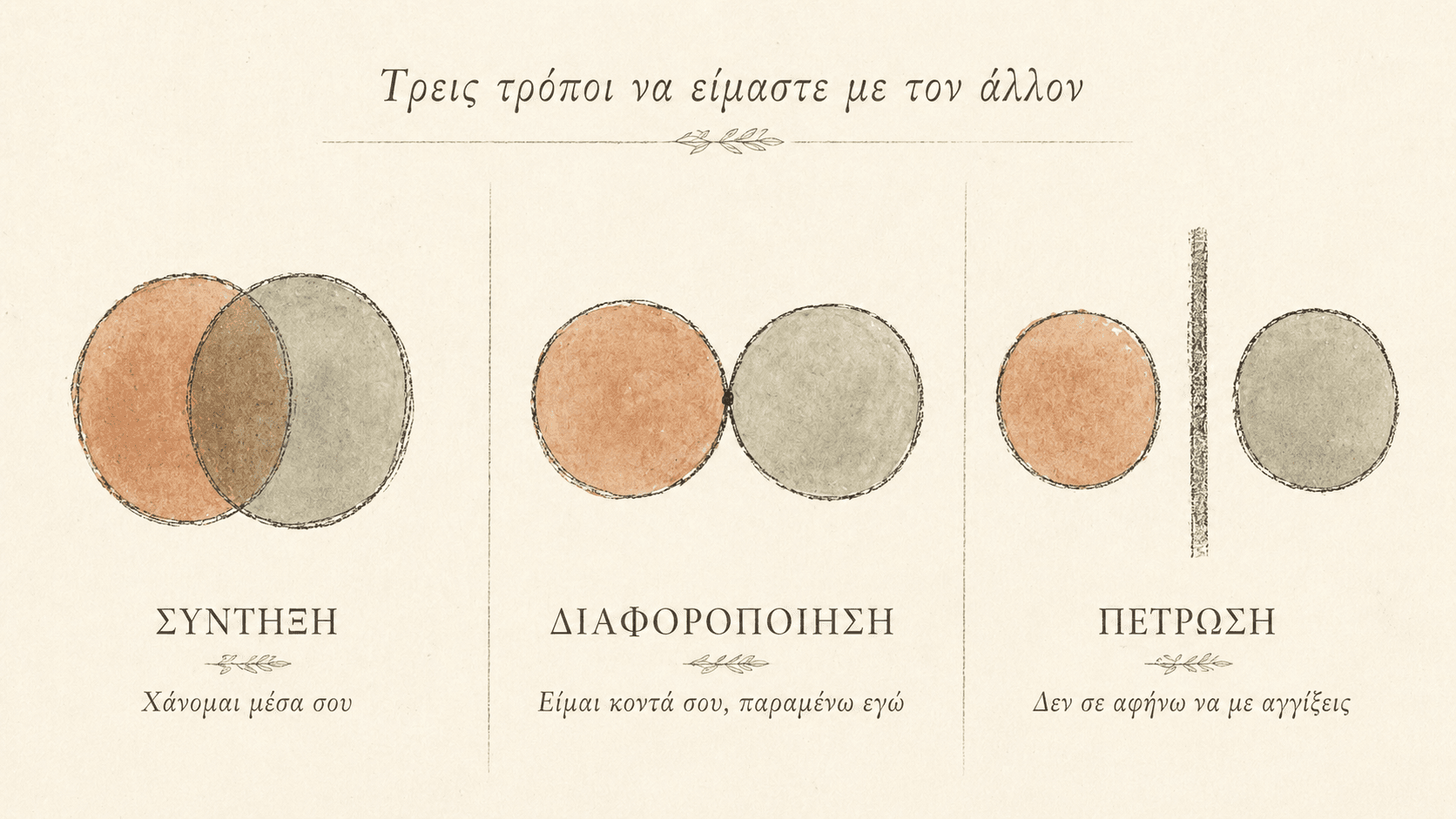
In clinical practice, the failure to differentiate takes two seemingly opposite forms. In fact, they are two sides of the same coin.
On the one hand, fusion. People who live attached to the emotional state of others; who cannot distinguish what they themselves feel from what those close to them feel; who say “yes” before they have even had time to ask themselves what they want. Pete Walker’s work and the contemporary literature on the so-called fawn response — the fourth survival response after flight, fight, and freeze — have illuminated this pattern as neurophysiological, not a character weakness. When in the early environment disagreement was dangerous and dependence on an unpredictable caregiver was unavoidable, the neural machinery selects appeasement as a survival strategy. In adulthood, the strategy remains active even when the threat is no longer present.
On the other side, petrification. People who have built an impenetrable wall around themselves; who experience every demand for closeness as an attempt at conquest; who disappear from any relationship that begins to become real. The fear behind this pattern is no different from that of fusion. It is the fear that, if left, one will be lost. The difference is only strategic — here defense comes first, not surrender.
Here lies an unusual angle to the story: the man who keeps saying “yes” and the man who keeps saying “no” are not opposites; they are brothers. Both are trying not to get lost in the relationship. They only change the method.
The experience behind both patterns is often linked to what Winnicott described as collapse anxiety — the fear of an inner dissolution that has never been processed. When this anxiety resounds in the background, the relationship becomes dangerous in both directions: closeness threatens absorption, distance threatens nonexistence.
Examples from everyday life
An adult daughter cannot hang up the phone when her mother complains about her father. She physically feels a tightness in her chest, as if she is gasping for air. If she leaves, she is overwhelmed with guilt. If she stays, she is exhausted after the conversation. In therapy, she gradually discovers that, since the age of ten, she has functioned as a psychic container for her parents' marriage. This role has never been withdrawn. The boundaries here are not absent due to ignorance — they are absent because there is an internalized belief that, if she withdraws, her mother will not be able to bear it.
A partner reports that he “disappears” after the first four or five months of every relationship. At first, he is passionate and completely available. As intimacy begins to take hold, he suddenly feels “not breathing.” He begins to find fault with his partner, cancel meetings, invent work obligations. He is not cynical. He is terrified. When the relationship ends, he feels relief that soon gives way to a pervasive sadness.
A professional says “yes” to every request at work. He takes on other people’s projects, stays up late, answers emails on the weekend. He functions flawlessly—until the day his body breaks down with a panic attack at the office. In the first few sessions, he has difficulty naming what he is feeling. Everything is “okay.” Over time, he discovers that since childhood he has learned that his only constant source of value was his usefulness to others.
All three examples show the same thing from different angles: boundaries are not a technique, they are an identity.

The therapeutic relationship as a space of differentiation
Psychotherapy does not teach boundaries. It creates them.
The therapeutic setting itself — the fixed time, the fixed cost, the fixed session length, the specific frequency — are not formalities. They are boundaries embodied in structure. Within them unfolds something that many patients have never encountered: a relationship where the other remains available and distinct. He does not disappear when I disagree. He does not overwhelm me when I agree. He doesn't need me to survive.
In transference, old boundary patterns are revived. The patient who functions in a fawn response in his relationships will try to guess what the therapist wants to hear in therapy. The avoidant patient will start canceling sessions when he starts to feel connected. These movements are not side effects of therapy—they are the very material of it. Their encounter with a therapist who neither leaves nor clings, who comments but does not impose, is often the first real experience of a differentiated relationship.
Peter Fonagy and his team at the Anna Freud Centre have described this process in terms of mentalization and epistemic trust. Intellectualization is the ability to hold the other in my mind as a separate subject with his or her own thoughts, desires, and intentions, without confusing him or her with my own fears or needs. Epistemic trust is the openness to learn from the other. When in early life the messages were confusing or abusive, this openness closes — what Fonagy calls “epistemic petrification.” The therapeutic relationship works exactly there: in slowly restoring the ability to trust social information again without losing one’s judgment.
As discussed in the article on the emotional mother-infant connection in the first year of life, the primordial womb from which the capacity to be simultaneously connected and distinct is born is the caregiving relationship. When that relationship has not provided adequate support, therapy can become a new context where the process begins again — slowly, imperfectly, but truly.

Simply put
Boundaries don’t mean walls. They mean I can touch you without getting lost in you. They mean I can disagree without the relationship being destroyed. They mean I can say “no” without feeling like you’re going to abandon me. They mean I can say “yes” out of true choice, not out of fear. It’s not a technique. It’s an inner skill that was built—or not built—in my early relationships, and that can be rebuilt in new ones.
To the point
Boundaries are not rules of behavior but a mental function. They are formed through the gradual differentiation of the self in early relationships. Failure of this process doesn’t just produce fusion; it also produces avoidant isolation. Neurobiologically, the self-other distinction is based on networks that can be reorganized in adulthood. Empirical research on differentiation of self shows a strong connection to mental and physical health. Psychotherapy does not teach boundaries—it provides them as a lived experience within the relationship.
Conclusion
There is a common fantasy in contemporary culture: that boundaries are something one learns in a seminar or by reading a book. Clinical reality shows something else. Boundaries are built in the relationship. First in the early one—the one we did not choose. Then, if necessary, in new relationships that can bring corrective experience; as a rule, in therapy.
Differentiation is not a conquest completed once. It is a constant inner movement: I remain as I encounter the other; I return to myself when I am lost; I allow the other to be separate without experiencing this separateness as rejection. It is not easy work. As analyzed in the article on mental resilience, it is one of the most mature indicators of mental functioning.
As a psychotherapist, I observe that when this ability begins to be restored, something fundamental changes in the person's relationship with his life. He does not become harsher — he becomes more present. He does not distance himself — he becomes available. He does not say “no” more — he says “yes” more truly. Finally, closeness ceases to be a danger and becomes what it was always intended to be: an encounter.