
Separation anxiety in childhood and adult life: why we don't outgrow it, it just changes face
Separation anxiety is not just a childhood phase that passes. It often transforms and returns in adult life in new forms. What research shows and how psychotherapy approaches it.
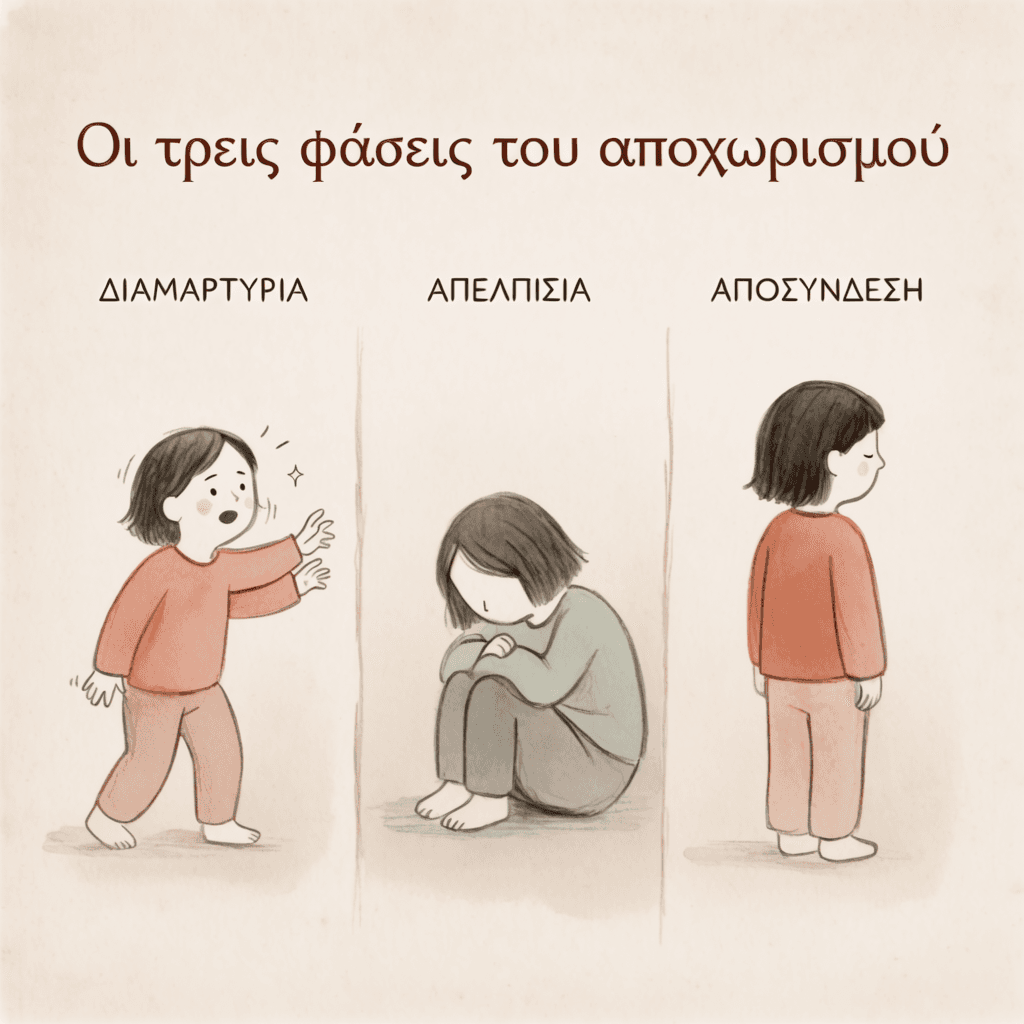
A familiar story A man in his forties cannot sleep on the nights his wife is away on a work trip. It is not jealousy — he knows this, he has checked a thousand times. It is something more physical: an unease in his stomach, a need to know she arrived, that she is fine, that she will come back. He sends messages he himself finds excessive. When she replies, he settles for a while. Then the unease returns. If you asked him, he would describe himself as "a rational person." And he is. It is just that, somewhere inside him, something very old switches on every time a loved one moves away. We tend to imagine separation anxiety as something childish. The picture that comes to mind is the toddler crying at the daycare door, the little girl clinging to her mother's leg. We treat it as a phase — something a child "outgrows." Clinical reality, and the data from research, show something very different. Separation anxiety does not disappear with age. It often simply changes shape, hides behind other symptoms, and returns in adult life wearing faces we don't immediately recognise. It's worth looking at the phenomenon across its full span — from the first observations in 1950s hospitals to the contemporary epidemiology that overturns much of what we thought we knew. Bowlby: the anatomy of separation in three phases The systematic study of separation begins with a film. In 1952, John Bowlby and his colleague James Robertson made the documentary A Two-Year-Old Goes to Hospital, recording a small child hospitalised without her mother during an era when hospitals enforced severe restrictions on parental visits. What they saw permanently changed how medicine treats children: many children, even after recovering physically and returning to their parents, showed profound changes in their personalities. From these observations, and later across his trilogy Attachment and Loss (1969, 1973, 1980), Bowlby described a consistent sequence of three phases in a child's response to prolonged separation. First comes protest: the child cries loudly, searches desperately for the parent, expresses anger, bangs on the door, refuses comfort from strangers. It is an active, almost aggressive attempt to restore the bond. When protest brings no result, despair follows. The child appears to "calm down" — but this calm is deceptive. It is in fact a state of mourning: the child withdraws, moves slowly, cries monotonously or falls silent, and seems to have given up hope of reunion. Many adults remember this state from their own childhood as a sense of "giving up inside." Last comes detachment. The child returns to seemingly normal behaviour, plays again, accepts care from others. But something has changed. When the parent returns, the child may show no interest — or may even reject them, turn away, behave with anger. Bowlby understood that this apparent "recovery" was in fact a defensive cutting-off of attachment feelings — a mechanism that, if separation repeats, can leave long-term marks on a person's ability to trust and connect. The crucial point, often overlooked: Bowlby did not describe these phases as exclusively childish. He saw them as the fundamental, universal response of the human psyche to the loss of a bond — at any age.
Ainsworth and internal working models If Bowlby gave us the theory, Mary Ainsworth gave us the way to measure it. In her famous "Strange Situation" experiment, developed in the late 1960s, she systematically observed how infants react when the mother leaves the room briefly and then returns. She was not so interested in the separation anxiety itself — all children get anxious. She was interested in what the child does at the reunion. From these observations came the well-known attachment patterns. The child with a secure attachment protests when the mother leaves, but is comforted quickly when she returns and resumes play. The child with an avoidant attachment appears indifferent — does not protest strongly, does not seek reunion, as if having learned that asking is pointless. The child with an ambivalent attachment clings and is angry at the same time: seeks comfort but is not comforted, remains anxious even in the embrace. Later, Mary Main added a fourth category, disorganised attachment, where the child shows contradictory, confused behaviour — often when the caregiver was simultaneously a source of safety and of fear. Bowlby called the mental representations a child builds from these early experiences internal working models — representations of the self, of others, and of what one can expect from a relationship. The child who learned that separation means catastrophe, that the other may not come back, that need will go unmet — that child does not "forget" the lesson. They carry it. And very often, they relive it in their adult relationships, as discussed in the article on the emotional bond between mother and infant in the first year of life. This continuity from child to adult is perhaps the most useful thing attachment theory gives us — because it lets a person recognise their own pattern. The adult who had a secure attachment as a child tolerates distance without reading it as a threat: a partner can be away, a friend can be slow to reply, and the bond stays felt as something stable inside. The adult with an ambivalent background experiences separation as a constant threat of abandonment — seeks constant reassurance, misreads a delayed reply as rejection, and their anxiety grows rather than settling with contact. The adult with an avoidant background does the opposite: has learned to need no one, keeps distance, experiences closeness as suffocating — not because they don't fear separation, but because they learned early to pre-empt it by withdrawing first. And the adult with a disorganised background oscillates between the two, in a confused pattern of seeking and pushing away at once, often because the person they once loved was also the one who frightened them. A clarification is needed here, one Ainsworth herself would stress: these patterns are not destiny. They are predispositions, not sentences. They are not "personality types" locked in forever, but ways the psyche learned to protect itself — and what was learned can be relearned. Later life — new relationships, experiences, therapy — can modify them. The neurobiology of separation: when the pain is literal There is something everyday language knew long before neuroscience confirmed it: we say a breakup "hurts," that a loss is "heartbreaking." It turns out these expressions are not metaphors. The social pain of separation activates, to a significant degree, the same neural circuits as physical pain. The neuroscientist Jaak Panksepp devoted much of his work to precisely this system. He named it first the PANIC system, and later PANIC/GRIEF, to better convey its nature as a mechanism of mourning and separation distress. It is one of seven fundamental emotional systems he described in mammals. The separation-distress circuit runs from the periaqueductal grey (PAG) of the midbrain to the anterior cingulate cortex, is activated by neurotransmitters like glutamate and the factor CRF, and — crucially — is inhibited by endogenous opioids, oxytocin, and prolactin. That last detail explains a lot. In a series of experiments from the late 1970s, Panksepp's group showed that small doses of morphine soothed the distress vocalisations of puppies separated from their mothers — and that oxytocin was equally effective. In other words, the system that makes us feel safe near a loved one and pain when we lose them uses the same neurochemistry as the brain's natural painkillers. It is no accident that losing a bond can feel like withdrawal — because, at a neurobiological level, it is something close to that. Panksepp also proposed something with direct clinical relevance: that many panic attacks may arise not from the fear system (FEAR) but from acute activation of separation distress. This hypothesis creates an unexpected bridge between separation anxiety and panic attacks — two phenomena clinical practice often meets together. A caveat, as always. These neurobiological findings come largely from animal studies and from models still under debate. They do not explain everything, and the psychological experience of separation is always richer than its chemistry. But they remind us of something important: that the distress of the person who cannot bear to be separated is not "an exaggeration" or "a character weakness." It has deep, ancient roots in our biology. Adult separation: what the data show This is where the story turns. For decades, separation anxiety was considered by definition a childhood disorder — the DSM-IV itself required onset before the age of eighteen. Research, though, forced the scientific community to change its mind. The large epidemiological study National Comorbidity Survey Replication in the US revealed that Adult Separation Anxiety Disorder (ASAD) has a lifetime prevalence of around 6.6% — meaning it affects roughly one in fifteen people at some point in their lives. And the most striking finding, documented in the review by Bögels and colleagues (2013) for the DSM-5 workgroup: more than half of adults with ASAD developed the symptoms for the first time in adulthood, with no history of childhood separation anxiety. On the basis of these data, the DSM-5 in 2013 removed the age restriction: separation anxiety is now officially recognised as a disorder that can begin at any phase of life. In clinical populations, the numbers are even more striking. Research groups, particularly that of Silove and Manicavasagar at the University of New South Wales, found that 20 to 40% of adult psychiatric outpatients meet the criteria for ASAD. The problem is that it is rarely diagnosed as such. Because its symptoms resemble other disorders, adults with separation anxiety often receive diagnoses of panic disorder, agoraphobia, generalised anxiety disorder, or dependent personality disorder. Separation anxiety hides, in other words, behind other names. What does it look like in its adult form? Excessive distress when facing or merely anticipating separation from loved ones. Persistent, disproportionate worry that something bad will happen to them — or that they will be lost for good. The fear of being alone. Difficulty sleeping away from home or without the loved one nearby. Physical symptoms — headaches, nausea, palpitations — as separation approaches. It is worth noting that research shows separation anxiety to be more common in women, though the reasons remain under debate. When is it normal, and when is it a disorder? Having come this far, a reader reasonably wonders: "but don't we all feel anxious when we're separated from those we love?" The answer is yes — and it is important to say this clearly, because the difference between normal and pathological separation anxiety is not a matter of kind, but of degree, duration, and impact. Separation anxiety, in moderate amounts, is not only normal but healthy. It shows that we have bonds that matter to us. The child who is sad when their mother leaves on the first day of school, the adult who feels a tightening when saying goodbye to a partner at the airport, the mother who tears up when her child leaves to study in another city — these are all expressions of love and attachment, not symptoms. A psyche that felt no anxiety at separation would actually be more concerning — it would suggest a cutting-off from the bond, not mental health. So where does the line fall? The clinical distinction rests on three criteria. The first is intensity relative to reality: when the distress is disproportionate to the actual danger — when a few hours' absence triggers catastrophic thoughts, when an unanswered call generates images of death. The second is duration and persistence: normal anxiety subsides as we adapt, while pathological anxiety stays undiminished or even worsens over time. The third, and perhaps most decisive, is the degree to which it restricts life: when anxiety begins to dictate decisions — refusing opportunities, avoiding travel, being unable to work or sleep, organising one's whole existence around avoiding separation — then we have crossed from normal feeling into clinical disorder. In other words, it is not a "problem" that we care and feel anxious. It becomes a problem when anxiety stops being a signal of love and becomes a prison. This distinction has practical value too: it helps us avoid pathologising normal feelings, while also not ignoring symptoms when they genuinely call for attention and support. How it shows up in everyday life A mother cannot let her ten-year-old son go to his first summer camp. She tells herself she's worried about him — that he might get sick, might feel lonely. In reality, it is she who cannot bear his absence. In the days before departure she becomes irritable, doesn't sleep, finds reasons to cancel. When he finally goes, she spends the days counting the hours until his return. The child, oblivious, has fun. The anxiety is entirely hers — and it has roots in her own, very old story of separation that was never worked through. A man constantly checks where his partner is. He is not jealous in the classic sense — no rival concerns him. What concerns him is the distance itself. When she is slow to answer a message, his mind automatically goes to the worst: an accident, a catastrophe. His reason knows this is irrational. His body, though, reacts as if facing real danger. What he feels is not suspicion — it is the primal anxiety that the bond may be lost at any moment. A young woman refuses every opportunity that would take her away from her hometown — a job abroad, postgraduate studies, even holidays with friends. She explains her refusals with practical reasons, but the pattern is constant: anything requiring separation from her family feels unthinkable. It is not a lack of ambition. It is a separation anxiety that, invisibly, shapes the most important decisions of her life. In all three cases, the common element is not weakness. It is a deep, often unconscious conviction that separation equals loss, and loss equals catastrophe.
The therapeutic approach: from control to safety Therapy for separation anxiety does not aim to "eliminate" the fear. That would be both naive and impossible — the anxiety of separation is part of human nature, not a flaw to be removed. The goal is something subtler: the gradual shift from a psyche that experiences every distance as a threat, to a psyche that can tolerate distance because it carries within it a sense of safety. Bowlby used the term secure base to describe the function of the caregiver that allows the child to explore the world, knowing they can always return. The therapeutic relationship works, to a large degree, as a new secure base. Within its stability — the same hours, the same presence, the reliability of return every week — the patient experiences something they may not have had enough of in their earliest years: the experience that separation is not the end, that the bond survives distance. There is something here that often surprises those starting therapy: separation anxiety is not simply discussed within therapy — it shows up within it, live. The end of every session is a micro-separation. For some patients, the final minutes before leaving become charged with an unexplained tension; they start talking about something important exactly when the time is ending, as if unable to bear the parting. The therapist's breaks — summer, holidays, an illness — often activate the old anxiety with striking intensity: the patient may feel anger, cancel the next session, suddenly develop symptoms, or report that it "didn't affect them at all" (a reaction that, in the light of attachment theory, often says more than visible distress would). These moments are not side effects of therapy. They are its most valuable material. Within the relationship with the therapist, the patient has the chance to experience separation not as they once did — as abandonment or catastrophe — but in a new way: the therapist leaves and returns, again and again, reliably. Gradually, this repeated experience of return gets written in. The patient begins to internalise something new: that distance does not mean loss, that the bond holds even when the other is not in front of them. What was not built well enough in the earliest years is built now, slowly, within the therapeutic relationship. In psychodynamic work, what one works through is not so much the "symptom" as the old working model that feeds it. The patient begins to recognise when they are reacting to the present and when they are reacting to a very old loss. Gradually, they learn to distinguish real danger from the reflexive alarm. It is not a linear path, and it is rarely fast. But it is possible — and the very capacity to tolerate separation is, as discussed in the article on psychological resilience, one of the most important markers of psychological maturity.
In plain language Separation anxiety is not a childish whim you outgrow. It is the distress you feel when a person you need moves away — and it can stay with you your whole life. In a child it shows clearly: crying, clinging, fear of separation. In an adult it hides: constant checking, an inability to be alone, excessive worry about loved ones, panic when someone is away. It is not weakness. It is an old pattern that can change. To the point Separation anxiety was first described by Bowlby as a sequence of protest, despair, and detachment. Ainsworth showed how early attachment patterns predispose — without, however, determining for good. Neurobiologically, separation activates the PANIC/GRIEF system, which shares chemistry with physical pain. Contrary to common belief, separation anxiety is not only childish: it affects up to 6.6% of adults across their lifetime, and more than half develop it for the first time as adults. It often hides behind diagnoses of panic or agoraphobia. Therapy does not eliminate the fear — it builds an internal sense of safety that makes it bearable. A closing thought There is something consoling in understanding that separation anxiety is not a personal failure but a deeply human response, with roots reaching back to our evolutionary history. The infant who protests when the mother leaves and the adult who cannot sleep when the partner is away share the same primal system — a mechanism that once ensured survival by keeping the young close to the grown. The aim is not to stop caring, nor to become indifferent to distance. It is to reach a point where separation no longer triggers a survival alarm — where we can let a loved one go, knowing inside ourselves that the bond remains. This internal stability is not given to everyone from the start. But, as both clinical experience and contemporary research on neuroplasticity show, it can be cultivated — slowly, within relationships that teach us, at last, that to separate does not mean to disappear.