

Breakups: Why They Hurt Like a Death, and What We Actually Lose
Why a breakup hurts like grief, what we actually lose beyond the other person, why we mourn even those who hurt us, and how the self is rebuilt afterwards. A psychodynamic view.
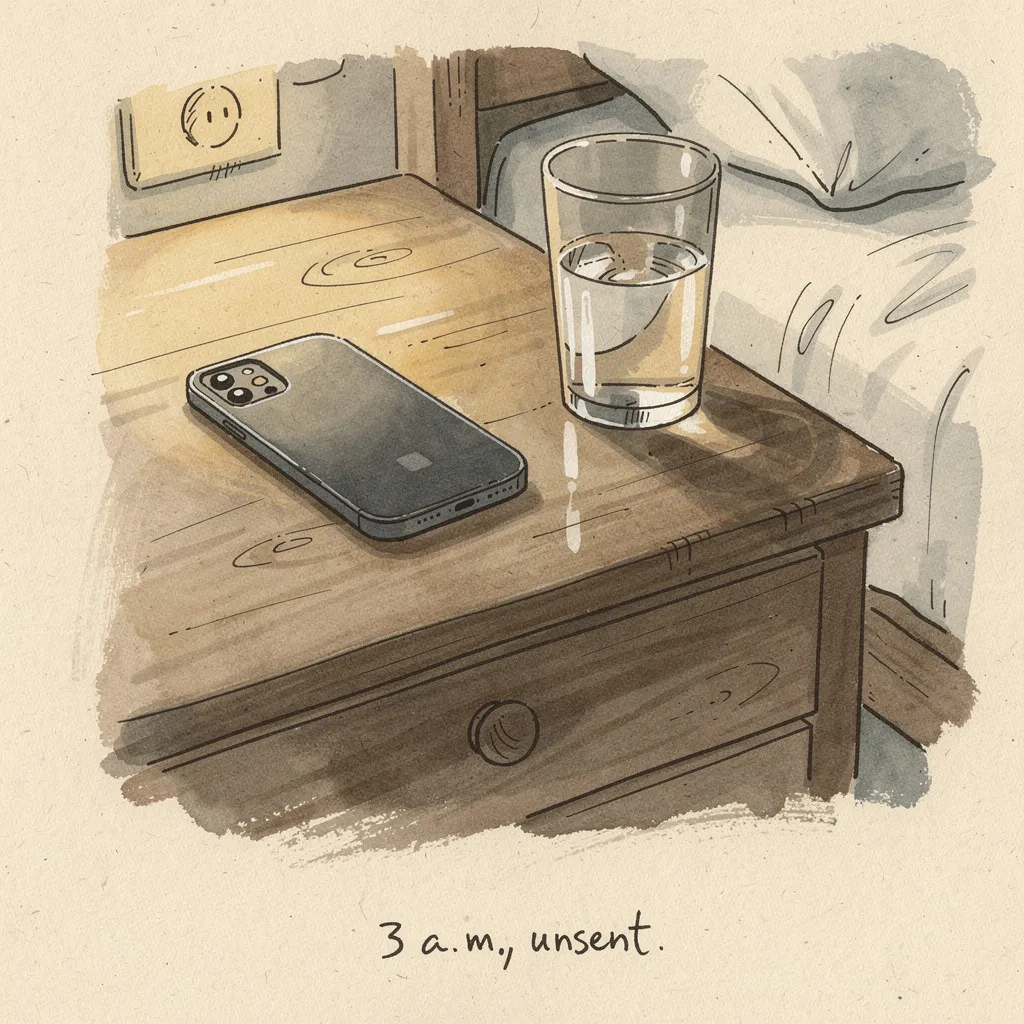
It's three in the morning and your hand has already found the phone. The message gets written, deleted, written again. The person it's addressed to is alive, well, possibly a few miles away. And yet they no longer exist, not in the way they used to. The message doesn't get sent. What's left is a body that won't sleep, a thought that circles itself, and a shame that always arrives second: it's only a breakup. Why do I feel as if someone died?
Psychodynamic thinking has a simple and entirely unconsoling answer to that question: because, psychically, someone did die. A breakup, far from being an unpleasant experience you get over with a bit of time and a few pieces of advice, is loss in the full sense of the word, with a grief that follows its own laws, and with one feature that often makes it harder than an actual death: the person you've lost is still there. This piece tries to say what exactly we lose when we separate, why the pain takes the shape it does, and what "moving on" really means.
The brain doesn't know the difference
In 2003, the neuroscientist Naomi Eisenberger and her colleagues put participants in an MRI scanner and had them play a simple digital ball game, from which, at a certain point, the other players excluded them. The exclusion was trivial, the game meaningless. The brain, though, responded by activating the dorsal anterior cingulate cortex, the same region that lights up when we're in physical pain. A few years later, Ethan Kross showed that when recently separated people looked at a photograph of their ex, regions activated that process the emotional and, equally, the physical dimension of pain.
The anthropologist Helen Fisher added the second piece of the picture. Scanning the brains of people who had been romantically rejected, she found intense activity in regions of the reward system, the same ones activated in substance addiction. The rejected lover, in neurobiological terms, isn't merely sad. They're in withdrawal.
This explains why the phrase "it's all in your head" is simultaneously literally true and completely useless as comfort. The pain of a breakup comes from a brain that evolved to treat the loss of a bond as a threat to survival, because for hundreds of thousands of years that's exactly what it was; exaggeration or weakness of character has no place in the explanation. Neuroscience, though, explains why we hurt. It doesn't explain what we've lost. For that, we need psychoanalysis.
Freud: the grief that doesn't know what it's grieving
In Mourning and Melancholia (1917), Freud described mourning as work: slow, painful, and absolutely necessary. When we lose someone, the psyche has invested an enormous quantity of energy in them, and the loss doesn't mean the investment is automatically withdrawn. It has to be withdrawn piece by piece, from every memory, every expectation, every habit tied to the lost person. Mourning is complete when that work is done, and then, Freud wrote, "the ego becomes free again".
In death, hard as that work is, it has one advantage: finality. The dead don't come back, don't send a message, don't turn up at a mutual friend's with someone new. Grief has a funeral, a ritual, social recognition. In a breakup all of that is missing. The other person is alive, often living well, and the psyche can't decide whether to mourn them or wait for them.
The family therapist Pauline Boss gave this state a name: "ambiguous loss". It's the loss with no clear boundaries, where the lost person is psychologically present but physically absent, or the reverse. Boss first studied it in the families of soldiers missing in action, but its structure applies almost intact to a breakup. Mourning can't proceed because it doesn't know whether it has the right to begin. The psyche, faced with that uncertainty, does the worst possible thing: it neither grieves nor hopes. It hangs suspended.
Bowlby: protest, despair, detachment
John Bowlby, in the 1950s, observed with James Robertson what happens to small children separated from their mothers for days or weeks, as was routine in hospitals at the time. He described three phases that followed with almost lawlike regularity. First, protest: the child cries, shouts, searches, refuses all other care, with its whole being bent on bringing the mother back. Then despair: the crying stops, the child withdraws, becomes passive and sad, as though it has understood the mother won't come. Finally, detachment: the child appears to recover, shows interest in its surroundings, but when the mother returns treats her with indifference or even aversion.
Those three phases replay in adult breakups with striking precision. The three a.m. message is protest: neither weakness nor lack of dignity, but the oldest mechanism of the attachment system trying to recall the lost figure. The period that follows, with sleep that won't come, food with no taste, a world gone grey, is despair. Detachment, when it arrives, isn't always healthy: it can take the form of a coldness the person begins to mistake for strength, when it's simply a defence.
There's a point here that explains why the same breakup is experienced so differently by different people. Those who learnt early that loss is reversible, that the mother who leaves comes back, that the relationship survives separation, can pass through the three phases and come out the other side. Those who learnt the opposite, that distance means abandonment, get stuck in protest or collapse into despair, because the breakup reawakens not only the present loss but every previous one. As explored in the article on dependency in relationships, the fear of loneliness that makes a breakup unbearable usually has roots far older than the relationship that ended.

What we actually lose: the self that existed only with them
Ask someone who has just been through a breakup what they miss and they'll list things that sound small. That someone knew how they take their coffee. That there was a person they could send the sunset photo to without needing to explain why. That when something went wrong, there was a voice that said "we'll sort it out", and the voice, in some inexplicable way, made it true.
Heinz Kohut, founder of self psychology, gave these "small" things theoretical weight with the concept of the selfobject. A selfobject is another person to the extent that they function as part of our own psychological equipment: less as a separate person with their own needs and more as a source of functions the self can't perform alone. Kohut described two core functions. Mirroring: someone to see us, to confirm that we exist and are worth something. Then idealising: someone strong and calm enough that, leaning on them, we become calm too.
A partner, in any relationship with depth, becomes a selfobject. And here lies the answer to the question in the title. In a breakup, beyond the person, we lose the functions that person performed on our behalf. We lose the mirror in which we saw a version of ourselves that, without them, we have nowhere left to see. We lose the calm we were borrowing. We lose, in the end, the self that existed only inside that relationship. That's why the question "who am I now" that torments the newly separated has nothing rhetorical or dramatic about it: it's literal. A piece of the self that was stored externally has left with the other person, and the psyche needs time to rebuild it from within.
Why we mourn even those who hurt us
The most misunderstood grief is grief for a relationship that was bad. Other people don't get it: if they hurt you, why are you crying? And the person feels doubly ashamed, for the pain and for hurting over someone who "didn't deserve it". Clinical experience, though, shows consistently that breakups from difficult, ambivalent relationships are often the most tormenting, and there are three reasons why.
The first is that in a difficult relationship the psychic investment is greater, not smaller. The person who spent years trying to make the relationship work has invested hope, effort, self-image in it, and all of that now has to be mourned. The second is that the mourning becomes ambivalent: love and anger for the same person, cancelling each other out and blocking the work Freud described. The article on ambivalence examines in detail why holding opposing feelings isn't confusion but the truest form of attachment. The third reason, and the most insidious, is that what we mourn in a bad relationship is, above all, the hope, far more than the person. The version of them who would have changed, the relationship that would finally have become what it should have been, the future we had imagined and which is now dying last.
Anger, in this grief, isn't a step backwards. It's a stage. Those who skip it, out of politeness or fear, often stay stuck in a sadness that never completes, because sadness without anger is grief for someone who never really left.
When grief gets stuck
Freud, in the same 1917 text, described what happens when mourning fails. He called the condition melancholia, and his description reads today like a clinical picture of the breakup that won't end. Instead of the psyche gradually withdrawing its investment from the lost person, it identifies with them: "the shadow of the object fell upon the ego". The abandoned person becomes, inside, the one who abandoned them, and the anger that should have turned outward turns inward as self-accusation: I wasn't worth it, I wasn't enough, it's my fault.
Idealisation is the other form of getting stuck. The ex-partner, as they recede, becomes ever more perfect in memory, until no real person can compete. That's denial of loss disguised as love, because a perfect relationship wouldn't have ended, so perhaps it hasn't really ended. The opposite, the hasty new relationship, often serves the same purpose by another route: if someone immediately takes the lost person's place, the psyche doesn't have to face the gap. The stages of grief rarely unfold in a straight line, and in a breakup even less so, because every chance encounter, every photograph, every mutual friend can send a person back into protest.
One special case deserves mention: divorce with children. Here the grief has no funeral, and often no permission either. The ex-partner remains constantly present, as a parent, as a co-ordinator, as someone who has to be dealt with civilly every other weekend. Divorcing parents are asked to mourn someone they must simultaneously co-operate with, and the psyche, which isn't built for such contradictions, often chooses not to mourn at all. The cost of that is paid years later.
Rebuilding: the self afterwards
Bowlby called the third phase "detachment", and the word has been misunderstood. It doesn't mean forgetting. It doesn't mean indifference, nor that the person has "got over" the other in the sense of ceasing to think about them. Healthy detachment is the transformation of the other from present to remembered: from someone the psyche waits for, searches for and claims, to someone who was, who left a mark, and who now belongs to the past with all their significance intact.
The difference is subtle in wording and enormous in experience. Moving on means being able to think about the other person without falling apart, not getting through a day without thinking about them at all. Meeting the memory, the song, the street, and feeling sadness or tenderness or even gratitude, instead of panic. The self that gets rebuilt after a breakup differs from the old one, the one before the relationship: it has internalised what the relationship gave, and has learnt to perform alone the functions it once assigned to someone else.
Winnicott, in a short paper from 1958, spoke of the capacity to be alone as an achievement gained, paradoxically, inside a relationship: the child learns to be alone by playing quietly while the mother is in the room. A breakup tests exactly that capacity. Those who acquired it early find it again after the protest and the despair. Those who didn't acquire it build it now, often for the first time, and that may be the only gift a breakup contains.
The therapeutic approach
As a psychotherapist, I know that a breakup is one of the commonest reasons someone walks through my door for the first time. I also know, from the same experience, that it's almost never only the breakup. The person comes for the present loss, and within a few sessions the present loss reveals the older ones: the father who left, the mother who was there without being there, the first abandonment that was never named. A breakup rarely creates the trauma of separation; it usually uncovers it.
Psychodynamic therapy offers, first of all, what the breakup withholds: ritual. A fixed place and time where the grief that has no funeral can finally be carried out, with a witness. The therapist doesn't rush to "help the person move on", because rushing is exactly what obstructs the work of mourning. Instead, they help separate the threads: which part of what hurts belongs to the relationship that ended, and which belongs to older stories the relationship merely reawakened. The second is usually the heavier, and it's what will reappear in the next breakup, with a different face, if it isn't worked through.
There's also the question of identity, which therapy takes seriously rather than dismissing as melodrama. Who am I without this relationship? The article on boundaries and differentiation examines the capacity to remain yourself inside a relationship; a breakup shows, after the fact and often painfully, how much of the self a person had left outside themselves. Therapy becomes the place where that part returns, not as loss but as recovery.
In plainer words
A breakup hurts like a death because psychically it is one: the brain processes the loss of a bond with the same circuits it uses for physical pain and withdrawal. We mourn, beyond the other person, the self that existed only with them, the functions they performed for us, and the future we had imagined.
Grieving a breakup is harder than grieving a death because it has no finality: the other person is alive, and the psyche doesn't know whether to lose them or wait for them. It passes through protest, despair and detachment, just as small children do when separated from their mothers. We mourn even relationships that hurt us, because there we mostly mourn the hope. Moving on doesn't mean ceasing to think about the other person, but being able to think about them without falling apart.
A closing thought
There's a phrase you hear often after a breakup, from well-meaning friends: "you'll find someone better". The phrase skips over exactly what needs to happen. Before finding someone else, a person needs to find themselves again, that piece they had stored in the other and which now has to be rebuilt from within. That work is done through mourning, through time, and often with help; it's never done through replacement.
Anyone who is at three in the morning right now with the phone in their hand might hold onto one thing from all this: hurting this much means they loved, and nothing is wrong with them. It means they invested, they let someone become part of them. That capacity survived the relationship intact, and it's the one thing they will certainly carry into the next, whatever it is, and whenever it comes.
Theoretical sources
For anyone who would like to read further, the main sources this piece draws on, alphabetically:
Pauline Boss, Ambiguous Loss (1999), on loss without clear boundaries and without ritual.
John Bowlby, Attachment and Loss, Volume 3: Loss (1980), and his observations with James Robertson in the 1950s on the phases of protest, despair and detachment.
Naomi Eisenberger, Matthew Lieberman and Kipling Williams, "Does Rejection Hurt?", Science (2003), the study demonstrating the shared neural basis of social and physical pain.
Helen Fisher and colleagues, for neuroimaging research on romantic rejection and activation of the reward system.
Sigmund Freud, Mourning and Melancholia (1917), the foundational text on the work of mourning and the mechanism of melancholic identification.
Heinz Kohut, The Analysis of the Self (1971) and The Restoration of the Self (1977), on the selfobject and the functions of mirroring and idealising.
Ethan Kross and colleagues, "Social rejection shares somatosensory representations with physical pain", PNAS (2011).
Donald Winnicott, "The Capacity to Be Alone" (1958), on solitude as a capacity born inside relationship.