

What Is Psychodynamic Psychotherapy: Everything Worth Knowing Before You Start
What psychodynamic psychotherapy is, what actually happens in a session, how it differs from CBT, and what the research says about whether it works. A guide written by a psychotherapist.
Most people carry a picture in their heads when they hear the word "psychoanalysis", and it usually comes from films: a couch, a silent man with a notebook, endless conversations about your mother, and years going by with nothing visible to show for it. That picture has done more damage than most people realise. It keeps away precisely the people who would benefit most: those who suspect their problem won't be solved by techniques, because it lives somewhere deeper than the symptom.
Psychodynamic psychotherapy as practised today looks very little like the caricature. It happens face to face, usually once a week, with a therapist who talks, asks, comments and takes part. It isn't vague and it isn't endless, and the research evidence for its effectiveness is now among the strongest in the field. This piece is for anyone thinking about starting, or who simply wants to understand what psychodynamic therapists actually do, and why.

What it is, in brief
Psychodynamic psychotherapy is a form of talking therapy that focuses on how unconscious thoughts, feelings and early relationships shape the way we live and relate today. Its aim is not only relief from the symptom but understanding and changing the deeper patterns that produce it.
Behind that definition sit three assumptions that set the psychodynamic approach apart from every other. The first is that a large part of our mental life is not accessible to consciousness: motives, fears, wishes and conflicts operate without our knowledge and still determine choices we believe are free. The second is that the past hasn't passed. The relationships that formed us, especially the earliest ones, go on living inside us as internal templates, and we replay them with people who have nothing to do with the originals. The third, and probably the most important for anyone considering starting, is that change happens through a relationship, not through information.
That last assumption explains why psychodynamic therapy doesn't hand out leaflets, homework or lists of techniques. It doesn't consider them useless; it's simply aiming elsewhere.
From Freud to now: what stayed and what changed
In 1895, Sigmund Freud and Josef Breuer published Studies on Hysteria, describing an observation that sounded almost outrageous at the time: physical symptoms with no organic cause could recede when the patient spoke freely about whatever came to mind. One of Breuer's patients called it "the talking cure", and the name stuck. Everything that followed, free association, dream interpretation, the theory of the unconscious, was built on that single observation.
The classical psychoanalysis Freud developed had a specific frame: four or five sessions a week, the patient lying on a couch, the analyst out of sight, and a duration measured in years. That frame still exists and has its place, but it's now the exception. Psychodynamic psychotherapy, as it evolved through the twentieth century, kept the theoretical foundations of psychoanalysis and radically changed the frame: one or two sessions a week, sitting face to face, a more active therapist, and a duration that can be a few months or a few years depending on what the person brings.
The theory itself changed too, and here a common misunderstanding is worth clearing up. Psychodynamic thinking in 2026 is a long way from Freud's theory of 1900; it looks more like a whole tree with many branches. The object relations school, with Melanie Klein and Donald Winnicott, shifted the centre of gravity from drives to early relationships and how we internalise them. John Bowlby's attachment theory gave psychoanalytic thought the empirical base it had lacked, showing how the way we bonded with our first people becomes an internal map for every relationship after. Peter Fonagy, more recently, developed the concept of mentalisation: the capacity to understand ourselves and others in terms of thoughts, feelings and intentions, a capacity that develops or gets damaged inside early relationships and that therapy can restore.
What stayed constant is the core: that we are moved by forces we don't see, and that the only route to seeing them runs through a relationship safe enough to bear the looking.
What actually happens in a session
There's no agenda. That's the first thing that surprises most people when they start, and it often makes them anxious. In a psychodynamic session you're invited to talk about whatever is on your mind, in whatever order it comes, without filtering what's "important" and what isn't. The instruction Freud gave a century ago still holds, in a looser form: say whatever comes to you, even if it seems trivial, embarrassing or irrelevant.
The absence of an agenda isn't an absence of method. It is the method. When you talk without a plan, the way you move from one topic to the next, the places you stop, the words you choose and the ones you avoid, all of this reveals far more than an organised account would. The therapist listens on two levels at once: the content, meaning what is said, and the process, meaning how it's said, when, with what feeling, and what gets left out.
As a psychotherapist, one of the questions I hear most often before a first session is "what will you ask me?". The honest answer is that in the first session I ask a fair amount, because I need to understand what brings you to me, what you've already tried, what your history is, what you're hoping for. After that I ask less and listen more, not out of indifference: my questions would set the course, and therapy works best when the person sets it.
Silence deserves its own mention, because it's the element people find most frightening. In everyday life, silence in a conversation means awkwardness, disapproval or indifference. In therapy, silence is space. It's the time a thought needs to complete itself, a feeling needs to become noticeable, a word needs to be found. The psychodynamic therapist doesn't rush to fill it, not because they have nothing to say, but because they know that whatever they said would take the place of something that might have been about to surface.
Transference: why the relationship is the instrument
A woman who grew up with a strict, distant father starts therapy with a therapist who is, objectively, warm and approachable. Within a few weeks she begins to feel that the therapist is judging her, is disappointed in her, doesn't approve of her. None of this has happened. And yet the feeling is entirely real.
The phenomenon is called transference, and it may be psychoanalysis's most important discovery. We bring into the therapeutic relationship the way we've learnt to relate everywhere: the expectations, fears, defences and internal templates built in other relationships at other times. In daily life this happens constantly and goes unnoticed. In therapy, where the relationship itself is the object of attention, it becomes visible. And once visible, it can finally be examined.
The appearance of transference, far from obstructing therapy, is the very reason therapy works. You don't learn about your relational patterns by hearing them described; you live them, in real time, with someone who can recognise and name them without reacting the way everyone before them did. That's why anger at the therapist, disappointment, the feeling that "they don't understand me", are among the most valuable materials in therapy rather than signs that something has gone wrong. As explored in the article on ambivalence, the capacity to be angry with someone without losing them is one of the most significant things the therapeutic relationship has to offer.
There's the other side too, countertransference: the feelings that arise in the therapist towards the person opposite. For decades this was treated as interference to be eliminated. Today it's treated as information. If a therapist, for no obvious reason, starts to feel bored, worried, or excessively protective, that is data about what the person is communicating beyond words. Wilfred Bion described this as "containment": the therapist takes in the feelings the other person can't yet hold, processes them, and returns them in a form that can be borne.

How people change
The most widespread misconception about psychodynamic therapy is that it aims at "insight": that if you understand why you do what you do, you'll stop doing it. Anyone who has lived a little knows it doesn't work like that. People with excellent self-knowledge repeat the same patterns for years. Knowledge on its own changes nothing.
What changes is experience. The psychoanalysts Franz Alexander and Thomas French called it, as early as 1946, a "corrective emotional experience": living something, inside the therapeutic relationship, that differs from what you expected. Showing your vulnerability and not being mocked. Getting angry and not being abandoned. Revealing something you're ashamed of and meeting understanding instead of disapproval. Each such experience, repeated, slowly begins to rewrite the internal map.
Donald Winnicott spoke of a "holding environment": a relationship stable and reliable enough for a person to loosen the defences that once protected them and now imprison them. Fonagy added the idea that inside such a relationship the capacity for mentalisation redevelops: seeing ourselves from outside and others from inside, not fusing completely with a feeling but being able to observe it.
This is why psychodynamic therapy takes time, and honesty is owed here rather than evasion. The time it requires has a specific cause, and the cause isn't slowness: what it attempts, the reshaping of internal templates built over years, doesn't happen in six weeks. The patterns have to appear in the relationship, be recognised, reappear, be recognised again, until the new experience becomes stronger than the old. That's repetition with meaning, not delay.
Psychodynamic or cognitive-behavioural?
It's the question most people ask when they start looking, and it deserves an answer without tribalism. Cognitive-behavioural therapy (CBT) is a serious, well-evidenced approach with impressive results for specific problems. The two schools answer different questions, without being rivals.
CBT asks: which thoughts and behaviours are maintaining the problem, and how can we change them? It works in a structured way, with goals, exercises and a set number of sessions. It's excellent when the problem is clearly bounded: a specific phobia, an obsessive-compulsive behaviour, a panic episode that needs immediate management.
Psychodynamic therapy asks something else: why this problem, in this person, at this point in their life? What does the symptom serve? What would the person have to feel if the symptom went away? It fits better when the problem is diffuse or recurring: when someone keeps ending up in the same relationship with a different face, when anxiety has no particular object, when depression comes back every time life seems to be going well, when there's a sense of emptiness or meaninglessness that no symptom explains.
Research in recent years shows an interesting finding: when compared under fair conditions, the two approaches have similar effectiveness. What differs is what they count as an outcome and over what timescale. CBT often measures symptom reduction at the end of treatment. Psychodynamic therapy measures something broader, the change in how a person relates to themselves and others, and on that measure something happens that deserves its own section.
Does it work? What the data say
In 2010, the psychologist Jonathan Shedler published a review in American Psychologist that changed the conversation. Pooling data from multiple meta-analyses, he found an effect size of 0.97 for psychodynamic therapy. To put that in context: in psychological research, an effect size of 0.8 is considered large. 0.97 is comparable to or higher than that of many treatments marketed as "empirically supported", and larger than the effect size of antidepressant medication in most studies.
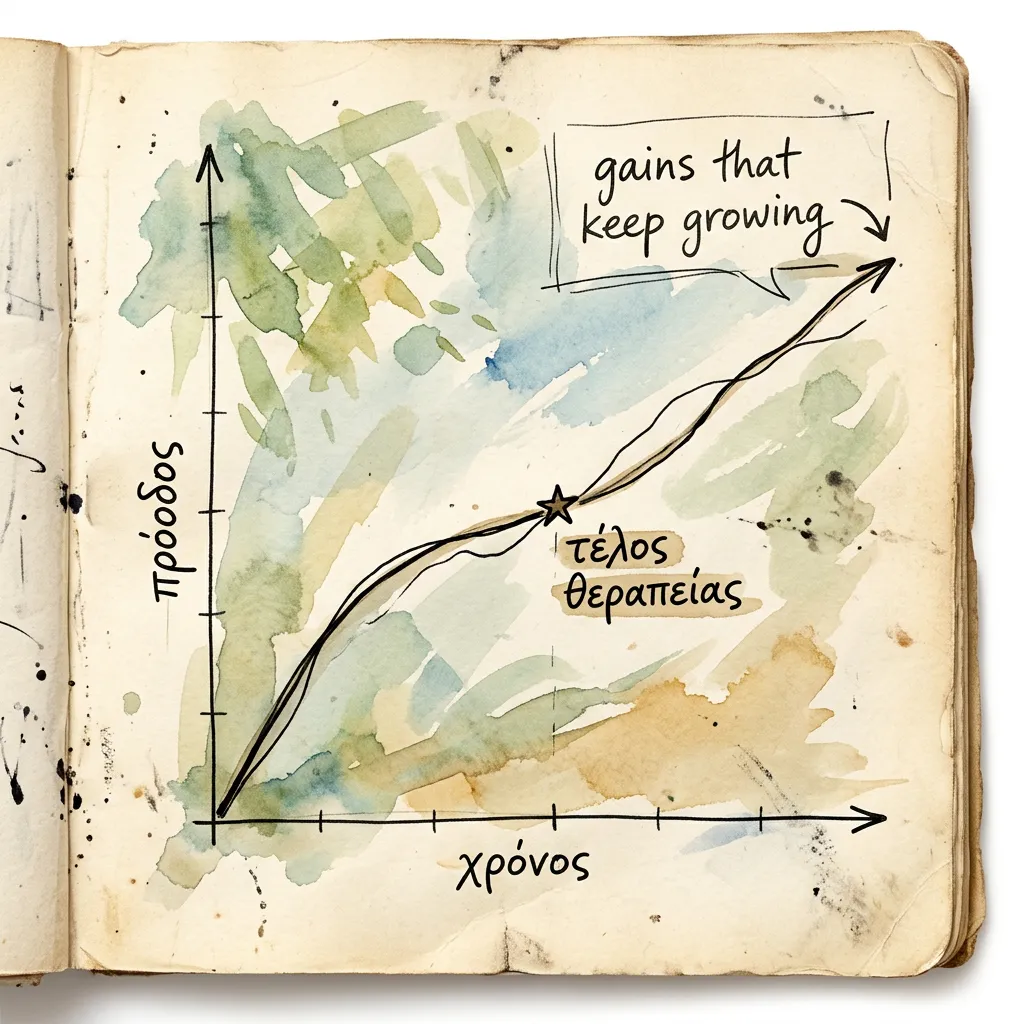
The most interesting finding, though, wasn't the number. It was the curve. In many therapies, gains peak at the end of treatment and then gradually fade. In psychodynamic therapy, follow-up studies showed the reverse: gains kept increasing months and years after sessions ended. The researchers described this as consistent with the theory: if what changes is the way a person relates and thinks, not just a symptom, then the change keeps working on its own after therapy finishes. The person has internalised something they carry with them.
Falk Leichsenring and colleagues, in a series of meta-analyses through the 2010s, confirmed the effectiveness of both short-term and long-term psychodynamic therapy for depression, anxiety disorders, somatoform disorders and personality disorders, with results equal or superior to the alternatives. Psychodynamic therapy is now included in the clinical guidelines of professional bodies in many countries.
A caveat is owed here too, because honesty is part of credibility. Psychotherapy research has structural difficulties no school fully overcomes. Long-term follow-up studies are fewer than they should be. The quality of the therapist and of the therapeutic relationship affects outcome more than the theoretical school does, as the "common factors" research shows consistently. That an approach works on average doesn't guarantee it will work for any particular person. What can safely be said is that the claim "psychodynamic therapy has no scientific evidence base" is, today, simply inaccurate.
Who it's for, and who it isn't
In my practice, the people who benefit most from psychodynamic work usually share one feature: they've already tried to solve their problem with logic, and it didn't work. They know their anxiety is out of proportion, and yet it doesn't leave. They know the partner they chose resembles the last one, and yet they chose them. They know success doesn't fill them, without understanding why. Psychodynamic therapy speaks to that sense that something is happening beneath the surface which the surface doesn't explain.
It's particularly suited to problems rooted in life history: the consequences of childhood trauma that express themselves silently in adult life, repeating relational patterns and dependency on the other, depression that returns or has no obvious cause, chronic anxiety with no object, a sense of emptiness, difficulties with boundaries, self-esteem and identity. It also suits people who have no "diagnosis" but feel they're living less than they could, and want to understand why.
There are cases, though, where psychodynamic therapy isn't the first choice, and that deserves saying plainly. In acute crisis, where safety comes first, stabilisation is needed before anything else. For very specific, isolated phobias, a targeted behavioural intervention may be quicker and sufficient. In serious psychiatric conditions, psychotherapy works alongside medical care, not instead of it. And there are people who, at a given point in their lives, need practical tools more than depth, and it's entirely legitimate to start there. A therapist who can't tell you "what you need right now may not be what I do" doesn't deserve your trust.
The practicalities: duration, frequency, online
The usual frequency is one fifty-minute session a week, on a fixed day and time. That regularity belongs to the therapeutic frame, not to bureaucracy: it provides the predictability on which trust can be built.
Duration varies more than people imagine. Short-term psychodynamic therapy, with a clear focus on a specific issue, can be completed in sixteen to thirty sessions. Open-ended therapy, for deeper or more diffuse difficulties, usually lasts one to three years. The decision to end is made together, when the person feels they've got what they came for, or when both of us recognise the work is done.
Online sessions, since the pandemic, have become an equal option, and the research shows that for psychodynamic work they don't fall meaningfully short of in-person. For Greeks living abroad this means something concrete: the possibility of doing therapy in their mother tongue, with a therapist who understands their cultural context, without having to translate their inner world into a second language. That isn't a small thing. The earliest and most important feelings are stored in the language of childhood, and that's where they're most easily found.
In plainer words
Psychodynamic psychotherapy is a weekly, face-to-face conversation with a trained therapist, in which you talk about whatever is on your mind without a set agenda. The therapist listens to what you say and, just as much, to how you say it, and gradually helps you see patterns that repeat in your life without your realising.
The idea behind it is that much of what troubles us has roots we can't see, often in early relationships, and that these change through a new and different relationship rather than through advice. It takes time because what changes is deep. The research shows it works, and that its benefits often grow after it ends. It suits anyone who feels their problem won't be solved by techniques, because it lives somewhere further in.
A closing thought
Starting psychotherapy is a decision usually made with hesitation, and the hesitation is reasonable: it's a relationship with no precedent in your life, with a stranger, around your most vulnerable places. Rather than promising to make the difficulty disappear in a few weeks, psychodynamic therapy promises a humbler and more permanent change: that you'll understand why your life seems to repeat itself, and that, inside a relationship that holds, you'll gain the ability to choose differently.
Freud said, with his characteristic severity, that psychoanalysis turns neurotic misery into ordinary human unhappiness. Today's psychodynamic therapists are more optimistic, and they have the data on their side. Beyond understanding pain, therapy offers the possibility of living more whole, freer from inherited scripts, and more capable of the relationships you actually want. A process like that is never entirely finished. But it begins in the first hour.

Theoretical sources
For anyone who would like to read further, the main sources this piece draws on, alphabetically:
Franz Alexander and Thomas French, Psychoanalytic Therapy (1946), where the concept of the corrective emotional experience is introduced.
Wilfred Bion, for the concept of "containment" and the therapist's function of processing what the patient cannot yet hold.
John Bowlby, Attachment and Loss (1969), the foundation of attachment theory and of the idea of internal working models of relationship.
Peter Fonagy and colleagues, for the theory of mentalisation and its role in therapeutic change.
Sigmund Freud and Josef Breuer, Studies on Hysteria (1895), the origin of the talking cure.
Falk Leichsenring and colleagues, a series of meta-analyses (2008-2015) on the effectiveness of short- and long-term psychodynamic therapy.
Jonathan Shedler, "The Efficacy of Psychodynamic Psychotherapy", American Psychologist (2010), the review that documented the effect size and the persistence of gains after termination.
Donald Winnicott, for the concept of the "holding environment" and the significance of a stable therapeutic frame.
Bruce Wampold and the "common factors" research, on the role of the therapeutic relationship in outcome regardless of theoretical school.