

Imposter Syndrome: Why Success Never Convinces You
Imposter syndrome: why success gets attributed to luck, which childhood roots feed it, and what the psychodynamic approach offers that confidence advice cannot.
The promotion is announced on a Tuesday morning, and the first feeling isn't joy. It's a cold drop in the stomach and a thought that forms before you can stop it: now they'll find out. Now they'll realise I was picked by mistake, that the previous wins were coincidence, that somewhere there's a genuinely competent person who should be here instead of me.
The paradox of this experience is that it doesn't fade with success. It intensifies. Each new achievement raises the stakes rather than proving anything: the higher you climb, the further the fall you imagine. People with doctorates, with awards, with decades of recognised work describe exactly the same sensation as the first-year student. Something clearly isn't getting through: the external evidence exists and still never arrives where it's needed.

What it is, in brief
Imposter syndrome is the persistent internal conviction that you don't deserve the success you have, that others overestimate you, and that at some point the "truth" will come out. It isn't a diagnostic category or a mental disorder, but a widespread experience that directly affects career choices, the relationship with work, and mental health.
The term was born in 1978, when the psychologists Pauline Rose Clance and Suzanne Imes published a study of a hundred and fifty high-achieving women, all with objectively documented accomplishments, who were nonetheless convinced they had fooled whoever selected them. The two researchers described three components that appeared consistently. First, success gets attributed to external factors: luck, timing, likeability, the fact that "it was an easy year". Second, there's a constant fear of exposure, the sense that the fraud will be discovered. And third, the most durable: any contrary evidence gets rejected or reinterpreted.
That third element explains why the phenomenon is so resistant. A belief system that absorbs and neutralises whatever contradicts it is, by definition, immune to more data.
The cycle that sustains itself
In clinical practice, the structure repeats with almost mechanical precision. An assignment arrives: a project, a presentation, a new post. The anxiety of exposure activates immediately. From there two roads open, apparently opposite.
The first is over-preparation. The person works twice the hours needed, checks and rechecks, leaves nothing to chance. The result, naturally, is good. And here's the crucial move: the conclusion comes out as "I got away with it because I worked excessively", never "I'm competent". Success is attributed to the over-effort, so the over-effort becomes mandatory next time.
The second road is procrastination. The person delays, panics, and delivers at the last minute. The result is again good, and the conclusion again saves the belief: "I pulled it off by luck." Either way, competence never gets credited to the self.
A second element keeps the cycle alive, more insidious than the first: secrecy. Almost nobody says it out loud. The nature of the belief forbids it, since admitting you feel like an imposter seems like handing over the evidence yourself. So the person looks around at colleagues who appear relaxed and certain, and concludes they're the only one. The statistics say otherwise: studies estimate that seven in ten people will experience this at some point in their lives. Yet each of them, inside their own silence, believes their case is the genuine one.
The cycle closes and restarts, with the stakes rising. And because over-effort has a cost, this road often leads to exhaustion. As explored in the article on burnout, what gets exhausted is the self built to serve the work, not the work itself. Imposter syndrome is one of the most reliable routes there.
The roots: when performance was rewarded, not the self
So why doesn't the proof land? The psychodynamic answer is that it's addressed to the wrong recipient.
Donald Winnicott described the distinction between a true and a false self. An infant who meets good enough care learns that it exists and is accepted as it is: when it's happy and when it's difficult, when it succeeds and when it fails. But when acceptance is systematically tied to a performance, the child does something logical and expensive: it builds a version of itself that produces what's being asked for. The false self is an adaptation, and often a very successful one; it has nothing to do with pretence.
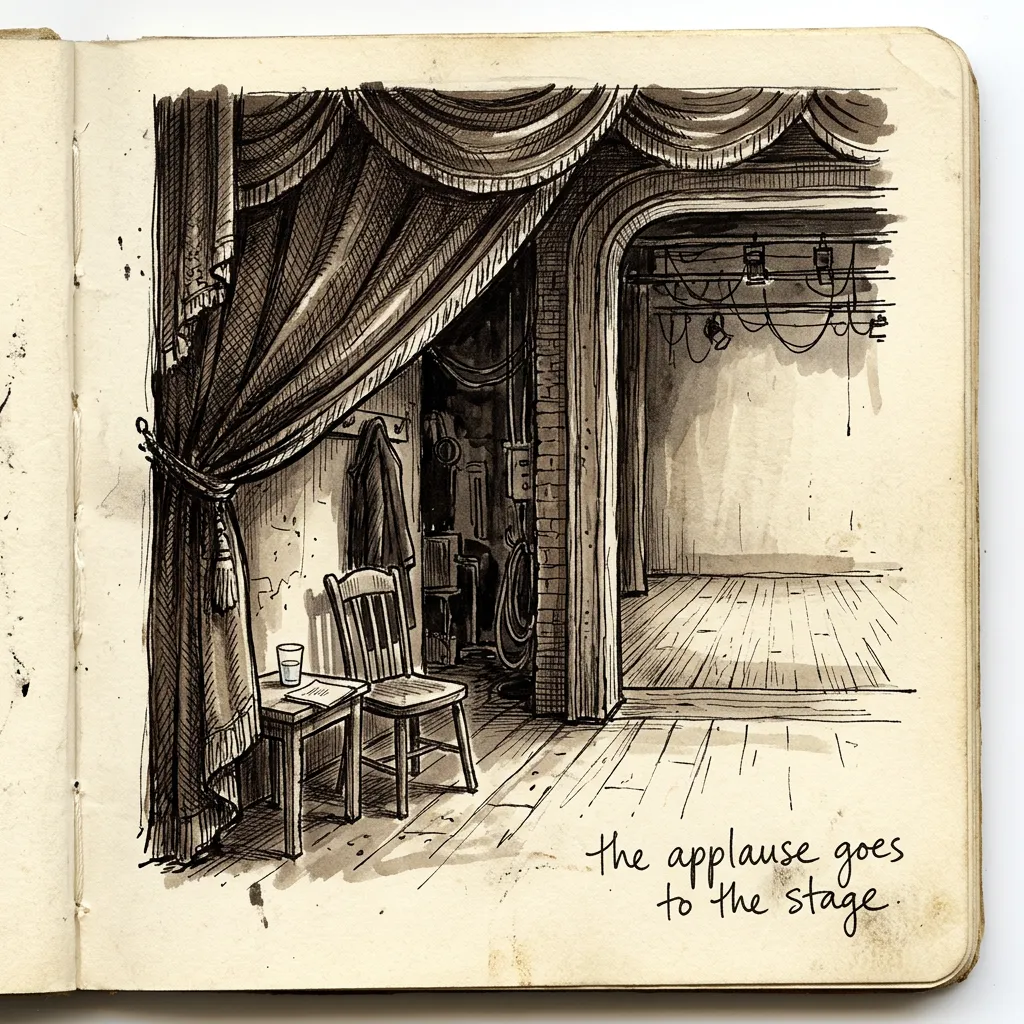
Here lies the heart of the syndrome. If the success belongs to the false self, then the feeling of fraud is, in a way, right. Someone genuinely is "performing", in the sense that what gets displayed and what's experienced as the real self don't coincide. The praise goes to the shop window and never reaches the storeroom. The person knows this, without knowing that they know it.
Alice Miller, in The Drama of the Gifted Child, described exactly this type: the child who was exceptionally good at reading its parents' needs and meeting them, who was rewarded for it, and who as an adult has a brilliant career and a deep sense of emptiness. The ability was real. The recognition, though, always went to the function being performed, never to the child itself.
Two scenarios, one outcome
In the stories I hear, two family patterns come up most often, and they're almost opposites.
The first is the "clever child". A child who managed easily and heard it many times: you're gifted, it just comes to you. Their worth became identified with ease. The problem appears when, inevitably, something starts requiring effort. If the identity says "I'm capable because I don't have to try", then every effort becomes proof of the opposite. These people often avoid challenges where they might have to struggle, and explain it to themselves as lack of interest.
The second is the child who was never enough. The eighteen out of twenty that met with and where did the other two go? Here no identity of competence was built at all; an internal judge was internalised who is never satisfied. As an adult, the person can accumulate every possible distinction and still hear the same voice.
Two entirely different childhoods, the same adult outcome: success never gets filed as mine. In the first case because it betrays the myth of ease, in the second because it never reaches the bar. These silent origins, as examined in the article on childhood trauma, rarely involve any dramatic event. Usually it's a climate, repeated across thousands of small moments.
Why praise evaporates
There's an observation almost everyone who lives with this makes: praise works, but briefly. A recognition, a good review, a thank you, bring relief for a few hours or days, and then the feeling drains away and the doubt returns, intact.
Heinz Kohut offers the explanation. In his theory of the self, a child needs mirroring: someone who sees and reflects back its worth, not only its achievements. Through thousands of such moments the function gets internalised; the adult acquires their own internal structure of self-esteem, which operates independently of external confirmation.
When that mirroring was insufficient or conditional on performance, the structure doesn't get built. The person is left with a need they can't meet alone and which must be continually replenished from outside. Praise then works as a temporary injection into a system that doesn't hold. Because nothing external suffices forever, the person seeks the next success, with the familiar result.
Where we meet it
The syndrome isn't randomly distributed. It appears most intensely in people who are, in some way, "the first" or "the different one" in their setting: the first graduate in the family, anyone who belongs to a minority within an environment, anyone who changed social context. When nobody around you resembles you, the assumption that you're there by mistake acquires apparent logic.
It's also common in creative and caring professions, where success criteria are vague and evaluation subjective. With no objective measure, the internal voice has free rein.
The link with depression deserves separate mention. A constant sense of inadequacy, combined with exhaustion from over-effort and with social withdrawal, forms ground where depression takes root easily. Often in outwardly successful people, whose difficulty stays invisible precisely because their performance doesn't drop.
The cost that doesn't show
Because the syndrome doesn't impair performance, its cost often stays invisible, even to the person themselves. It gets paid, though, in at least three currencies.
The first is opportunities not claimed. The post they didn't apply for because they met seven of the eight criteria. The raise they didn't ask for. The conference where they didn't propose a talk. From the inside, these choices feel like realism.
The second is the inability to enjoy. The moment of success, which should be the reward, gets consumed by calculating the next step and the risk it brings. Many describe not even remembering how they felt when they managed it.
The third, and heaviest, is loneliness. When you believe you're loved for a version of yourself that isn't the real one, no affection lands whole. Even love seems addressed to someone else.
It isn't cured by confidence
The usual advice is well-meant and almost always ineffective. Believe in yourself. Keep a list of your achievements. Remember they chose you for a reason. Anyone who has tried knows what happens: the logic agrees, the feeling doesn't move at all.
The reason is that it's addressed to the wrong level. The problem isn't a lack of information, it's the absence of an internalised experience of acceptance. The evidence isn't missing; what's missing is the structure that could receive it. A list of achievements, given to someone who systematically rejects every positive datum, is simply more data to reject.
A caveat is owed here, because over-diagnosis is a real risk. A measure of doubt about our abilities isn't pathology; it's a precondition of learning and of humility. The opposite of imposter syndrome is arrogance, the inability to question oneself. The line runs through functionality: when doubt stops you claiming, speaking, or enjoying what you achieved, it has become a problem. When it merely keeps you alert, it's probably serving you.
The therapeutic approach
As a psychotherapist, what I notice first is the moment the doubts appear inside our relationship, more than their content. And they appear almost always. The person starts worrying that they aren't a "good patient", that they aren't bringing interesting enough material, that they're wasting my time. Some apologise for crying. Some prepare for the session like an exam.
That moment is valuable, because it moves the problem from narrative into the present. The fear of exposure is no longer discussed theoretically; it's happening, here, with me. Then a different outcome becomes possible: nothing happens. Nobody withdraws, nobody is disappointed, the expectation isn't confirmed. The repeated experience of being accepted without producing anything is, for many, entirely new.
There's a second movement too, slower. Gradually we examine what exactly gets attributed where. When someone says "it was luck", the question isn't whether they're right, but what it would cost them not to be. Often the answer reveals that accepting their own competence would mean separating from a family position: the child who needed help, the sibling who didn't stand out, the daughter who mustn't surpass her father. Doubt, from this angle, also functions as loyalty to an old agreement, not just as suffering.
Psychodynamic psychotherapy works here on two levels at once. On one, it reconstructs the history: when did this person learn that love comes with an evaluation, whose is the voice they hear saying "not enough", what had to happen for them to be loved. On the other, more important, it offers the relationship inside which what wasn't built then can be built now. The aim isn't to convince someone they're competent, but to stop their worth depending on the answer to that question.

What actually helps
Beyond therapeutic work, there are moves that bring relief, provided they aim at reducing isolation rather than at persuasion.
The most effective is admission. Saying it out loud, to a colleague you trust, often works more directly than any list of achievements. The commonest response is "I feel exactly the same", and that one sentence does more than fifty reminders of success, because it cancels the uniqueness of the fraud.
It also helps to shift attention from outcome to process. The question "do I deserve this position?" has no answer. The question "what specifically did I do this week and what did I learn from it?" does, and it doesn't pass through the court of worth.
And there's a small, difficult exercise: accepting a compliment without cancelling it. No oh, it was nothing, no the team helped a lot. Just a thank you. Those who try it describe intense awkwardness, which is precisely the point: that's where you see how automatic the rejection has become.
In plainer words
Imposter syndrome is the feeling that you don't deserve what you've achieved and that at some point you'll be found out. It doesn't recede with more success, because success always gets attributed to something else: luck, over-effort, coincidence.
Psychodynamically, it often appears in people who as children were rewarded for what they produced rather than for who they were. A version of the self was built for display, and the recognition goes to that version, never reaching the real self. That's why praise relieves briefly and then evaporates.
It isn't fixed by confidence advice, because the problem isn't logical but relational. It changes inside a relationship where someone accepts you without needing you to prove anything.
A closing thought
There's a question worth more than "am I actually competent?". It's this one: what would happen if I weren't?
For most people living with this doubt, the answer reveals the real stake. They don't fear professional failure. They fear that without the performance, there would be no reason left for anyone to love them. That's where the wound is, and that's where the work happens.
Relief, when it comes, doesn't take the shape anyone expected. It doesn't arrive as certainty that we're worthy, but as something quieter: the gradual discovery that this question doesn't have to be answered every morning for us to get on with our day.

Theoretical sources
For anyone who would like to read further, the main sources this piece draws on, alphabetically:
Pauline Rose Clance and Suzanne Imes, "The Imposter Phenomenon in High Achieving Women" (1978), the study that first described the phenomenon and its three components.
Heinz Kohut, The Analysis of the Self (1971), on the function of mirroring and the development of an internal structure of self-esteem.
Alice Miller, The Drama of the Gifted Child (1979), on the child recognised for its function rather than for itself.
Contemporary research literature on the association of the phenomenon with burnout, depression, and the avoidance of self-advocacy.
Donald Winnicott, on the distinction between true and false self and the concept of good enough care.